Every few months I get bored, and I peek into people magazine online to see if there is any gossip about celebrities I still recognize.
I did this again yesterday, and as I was perusing articles about Ozempic (a topic for another day), I saw a headline that used the word “quietly.”
And if you looked at my face when I read that, I’d bet you 10 bucks that it carried an actual scowl.
Because I see AI overusing the word “quietly” in every context, including when I use it to help me write articles like the very one you’re reading right now, and it’s getting under my skin.
Into my core, in fact, if we want to be precise about it, where I feel a contraction of repulsion.
Why repulsion, if I admit that I use AI to help me with my own work?
Partially because the word “quietly” has become such an obvious AI tell, and partially because as an entrepreneurial mother who wears more hats than she has heads for, it means I have to spend more of my very precious time refining my marketing copy than I might want to every week.
Which is exactly what I’m trying to avoid, for reasons we’re about to discuss.
But in the context of today’s topic, the word “quietly” really does feel like the best word choice.
Because most of the women I see who are dealing with this issue are doing it quietly. It’s both ever-present and behind the scenes.
It’s a level of tension that stretching doesn’t fix, paired with exhaustion that sleep doesn’t fix.
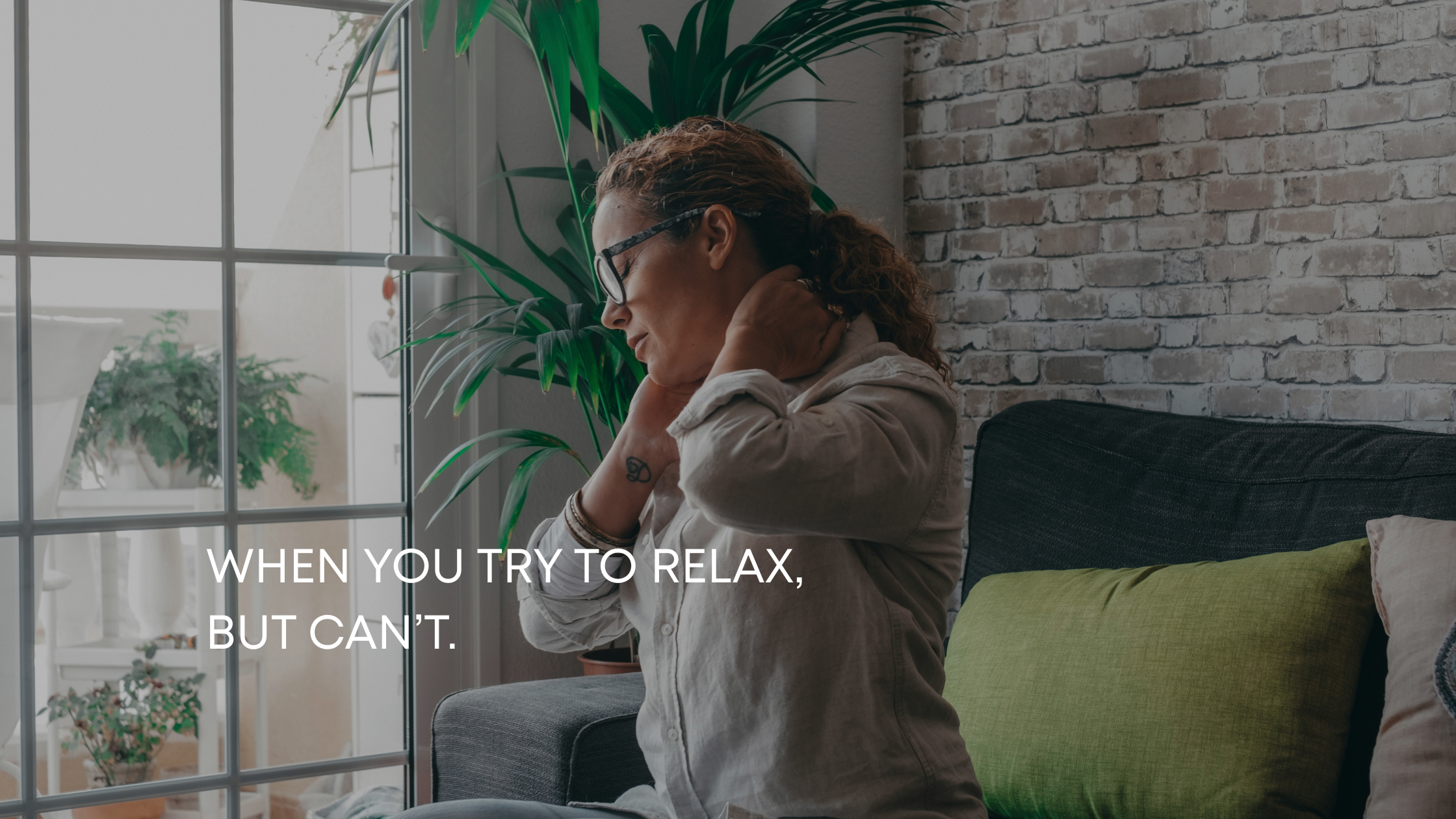
A patient told me last week that when she gets a manicure and the technician tells her to relax, she can’t. Her body just stays tense.
I’ve had more than one patient tell me that their shoulders are just always tight, to the point where they don’t even notice it anymore unless someone gives them a massage. Others describe symptom flares — a back that goes out, hip pain that comes and goes or migrates, sleep that won’t settle because they’ve been on alert for so long (usually since having kids) that deep sleep just isn’t available anymore.
For other women, getting to sleep isn’t a problem, it’s waking up that they struggle with. Even 9-10 hours doesn’t restore them, and they find themselves hitting snooze 5 times every morning and surviving on coffee all day.
I’ve also heard women tell me that they can go on a week-long vacation and come home even more exhausted, feeling like they haven’t recovered at all. Others tell me that whenever they try to rest, they feel too agitated and restless to sit still.
Everything that I’ve just listed is actually the same issue.
They’re all rooted in the stress patterns that have habituated themselves in your nervous system.
Why “just relax” doesn’t work
Here’s the deal. You cannot think your way into relaxation.
Believe me, if that worked, everyone I treat would already be there — they are, without exception, some of the smartest, most self-aware women I know.
They’ve read the books. They’ve tried the deep breaths, the journals, and meditation apps. They know, intellectually, that they’re safe.
But their bodies?
No matter how many stress management strategies these women try, their bodies never seem to get the memo.
They still startle too easily, and go straight into fight-or-flight whenever things don’t go exactly as planned (in other words, all the time).
From what I see in clinic, stress management isn’t working because it’s not going deep enough.
Chinese medicine talks about different kinds of energy.
And the deepest, most essential energy is Jing. It’s the life-force within the seed that will later allow it to sprout.
Jing is a kind of deep reserve, almost like an inheritance you’re born with. It’s the source energy that’s slowly spent over your lifetime, and its depletion is directly related to age-related symptoms.
When your lifestyle matches your biology, Jing doesn’t get depleted as quickly. You don’t have to draw on it to fuel your activities, because your body has ample opportunity to rest and recover.
But when you’re in constant go-mode, when you push through fatigue and overstimulation, and when your body doesn’t have the building blocks it needs from your diet and daily movement, you end up pulling from your Jing reserves.
This isn’t just theoretical.
Science is finally backing up what Chinese sages have taught for thousands of years, but scientists aren’t talking about Jing. They’re talking about mitochondria, the energy power-houses of your cells.
And mounting evidence is pointing toward the very real phenomenon of mitochondrial depletion.
Researchers like Dr. Martin Picard have shown that chronic stress actually changes how your mitochondria function — the tiny engines in every cell of your body that make your energy in the first place.
This isn’t “in your head” fatigue. It’s cellular.
Your body isn’t broken. It’s communicating.
Think about what modern life is asking our nervous systems to do.
Our bodies evolved to hear bad news from the next village over, maybe once or twice a week, and by the time it reached us, it had lost most of its charge. The emergency was too far away. Just gossip.
Now we hear about earthquakes and wars and disasters from the other side of the planet in real time, often with ominous music literally playing in the background, whenever we switch on a device.
We drive, which is itself a mildly life-threatening activity that our ancestors never had to do, moving through environments faster than our nervous systems evolved to process.
We have podcasts talking at us while we do the dishes (I love to do this too, but it’s important that we recognize the impact).
We scroll past hundreds of videos and ads and ads disguised as personal videos in a matter of seconds.
There is no off button anymore. Zero down time.
And we’re literally not built for it. There was never a version of human life that required us to metabolize this much input this quickly.
But for women? It’s next level.
Because there’s an invisible labor that (thank goddess) people are finally, slowly slowly (way too slowly) becoming aware of.
Now, I happen to be in a heterosexual marriage, raising two boys, so I feel the gender stereotypes playing out in my everyday life more than some might. Each situation is going to be as different as each relationship and individual in it, and none of this is true 100% of the time, for anyone.
But lemme tell you. The invisible load that women carry is real.
We were sold equality without ever renegotiating who tracks the birthday parties, who notices the stove is dirty, who remembers the pediatrician follow-up.
It bothers us more when the house falls apart than it bothers our male partners because we’re the ones held responsible, and we’re the ones judged for it.
And I don’t think that’s just a biological preference for cleanliness (though there’s definitely evidence pointing in that direction, too).
Whatever the reason, it’s exhausting in a way that you don’t realize until you live it. Or, for many women, until it feels like your body can’t keep up anymore.
Nothing grows in ease
Just as no relationship is simple, neither is this topic.
Because it’s also true that our bodies evolved to thrive through stress, not despite it.
Life is supposed to be challenging. Nothing grows in ease — not seeds, not muscles, not resilience, not a nervous system.
Stress has never been the problem.
The problem is that for most women, there’s no real recovery built in anymore.
Which is why support systems that work directly with your nervous system, like Applied Somatic Medicine™ (ASM), are so important.
ASM isn’t a magic wand that will make all of life’s challenges disappear.
What it does is reconnect you to your body enough that you start noticing what it’s actually asking for, in real time—instead of being forced to pay attention down the line when you keep yelling at your family or get diagnosed with an autoimmune disease.
When you start hearing your body’s messages, and responding in real time, it changes the way you feel at a fundamental level.
You stop pushing through as much because you realize how much it’s been costing you. I call this pattern of pushing through, of ignoring your body’s signals until stress has nowhere left to go but storage, Chronic Somatic Override™ — and once you can name it, it’s a lot harder to keep doing it on autopilot.
Your tolerance for what depletes you goes down, and meanwhile your capacity to handle the hard things goes up.
What your body is actually trying to do
Your body doesn’t mind short bouts of stress, but it also doesn’t want to get stuck there.
Under ideal circumstances, stress comes, your body contracts, and then it subsides and your body is able to relax again.
But when the stress load is more extreme or prolonged than usual—and whether or not you’ve experienced extreme stress or trauma, I can almost guarantee that your body has had longer stretches of prolonged stress than it was built to thrive on—in these cases, the body has other ways of releasing the pressure so it can return to normal.
These mechanisms are built into your nervous system, but our over-controlled society has labeled them as weird or unhinged, so they’ve been trained out of us.
Shaking, crying, moaning, sighing, sometimes yelling, sometimes twisting or tensing that looks nothing like what we’ve been taught relaxation should look like.
These are all part of Primal Release, and none of these reactions are a sign that something is wrong with you.
It is your nervous system finally letting something it’s been holding tight for years unwind so the energy can flow freely again, the way it’s supposed to.
The Nourishment Factor
I also think we need to talk about the fact that some of this exhaustion isn’t only external stress, it’s starvation, of a different kind.
Your body needs real food. Clean water.
Actual sunlight, actual fresh air, which most of us are chronically underdosed on.
My family keeps our windows open all year, even in the cold, because I’ve watched what stale indoor air and fluorescent light does to a nervous system over time. I go for jogs in the woods every chance I get, not just because I need the cardio, but because my body asks for it and I’ve learned to listen.
Slowness. Quiet. Birds chirping and wind through the trees.
Feet on grass, hands in soil.
Movement that isn’t punishment.
Short, appropriately hard stress like real exercise, the kind your body can recover from, instead of the kind that just keeps compounding.
If you’ve been trying to relax and your body just…can’t, it’s not just a sleep issue.
In my experience, it’s a depletion issue, and it’ll take consistency, patience, support, and non-negotiable prioritization to help your body learn to release, relax, and restore again.
If you feel exhausted and tense all the time, we’d love to help.
Book an Applied Somatic Medicine session at our women’s health clinic in Tigard, Oregon to get started.