I’ve seen a lot of therapists in my life.
In middle school, when I was struggling to keep up with a curriculum at a new school that suddenly felt too big for me, my therapist handed me a Rubik’s cube — one based on shape as well as color. I solved it during our session. She was showing me something I couldn’t yet see about myself: that I had my own kind of intelligence, my own strengths.
At the time I thought nothing of it. Years later I understood what a gift she had given me through her observation.
Another therapist, years later, reflected back to me that I was using coffee as a crutch. She wasn’t wrong. What was underneath that observation was deeper — I had a history of using it to override hunger, to manage a body I didn’t yet trust or feel at home in.
Both of those therapists —and others I’ve seen—gave me something real. Insight. Reflection. A new way of seeing myself. Tools to use to understand and manage my life.
But none of it made me feel better.
Not in my body. Not in the way I needed.
It wasn’t until I found yoga, and then qigong, and began weaving the physical experience of those practices together with the teachings of people like Pema Chödrön, Thich Nhat Hanh, Michael Singer, Eckhart Tolle, Byron Katie, and Gangaji — that something finally shifted.
Not in my mind. In my body.
In the tissue, the breath, the way I moved through a room.
For the first time, I felt free. Not because my circumstances changed. Because I changed — from the inside out.
That’s what somatic healing has the power to do.
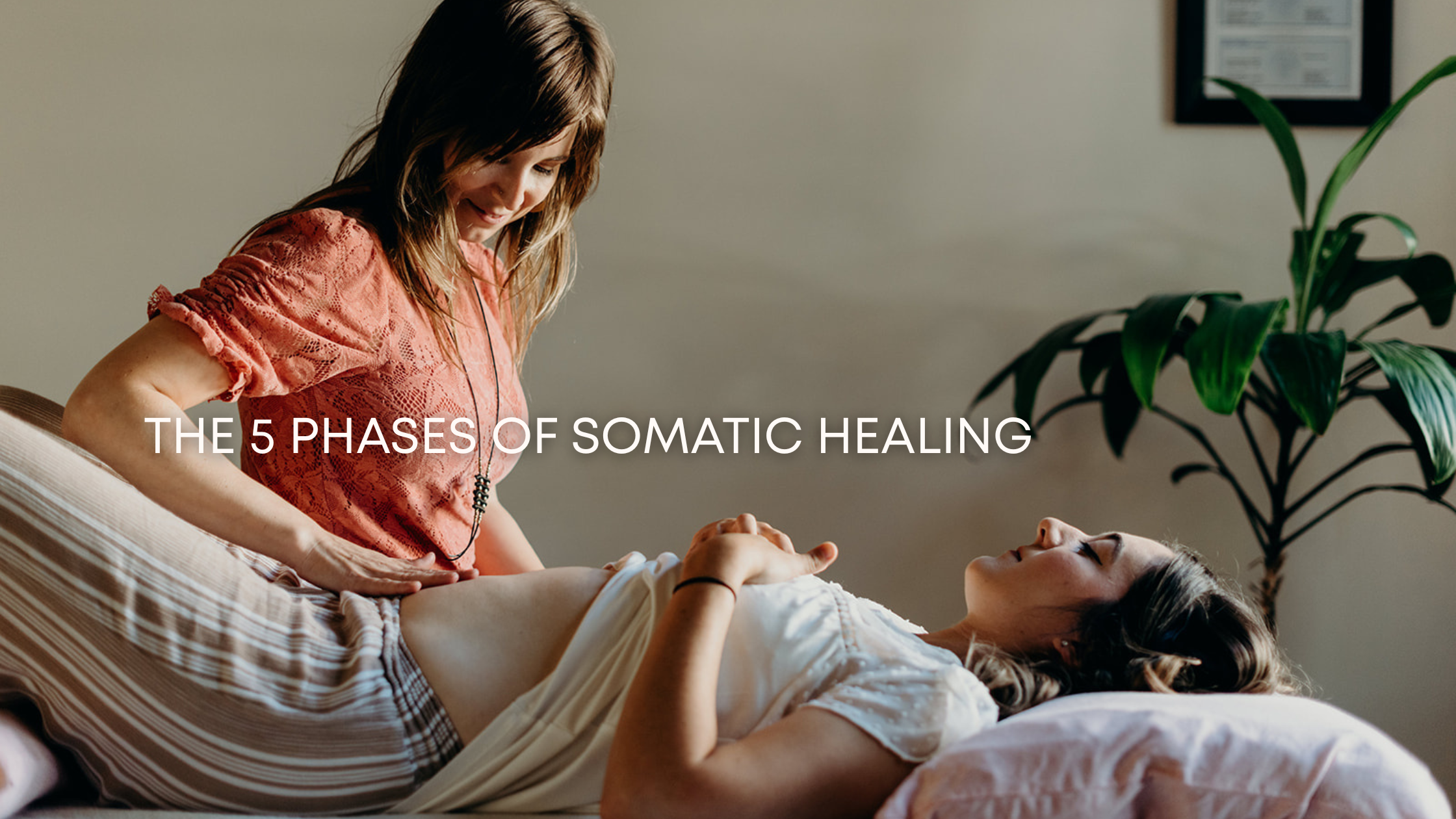
And in my years of practice — and my own healing — I’ve watched this process move through phases.
A map, not a prescription
Before we go any further, it’s important that you understand that these phases are not a staircase.
You don’t complete one and graduate to the next.
They overlap, they circle back, they sometimes happen simultaneously.
Some women spend years in one phase and move through another in a single session.
What this map gives you isn’t a timeline.
It gives you language — a way to recognize where you are, so you can meet yourself there instead of wondering why you’re not somewhere else.
Phase 1 — Holding
This is where most women start.
The nervous system is chronically activated.
Life is organized around effort — the effort of holding it together, keeping up, managing everything and everyone.
And underneath all of that effort, the body is still carrying the unprocessed pain of the past. Old stress, old hurt, old experiences that were never fully moved through — stored in the tissue, shaping the present.
The body is working hard just to function, and rest doesn’t actually feel restful because the body is always tense and ready to spring into action.
You may not even realize how much energy it costs to live this way. It’s become your baseline. What feels normal.
But let’s be clear: even survival mode isn’t a failure.
It’s the body doing exactly what it’s designed to do under chronic stress.
The problem is that most of us have never learned how to move out of our holding patterns — because the people around us never learned how, either.
This is why working with the body, not just the mind, can change everything.
Phase 2 — Release
Life force energy is movement. It’s meant to flow.
When we encounter something stressful, the body contracts — and this is intelligent.
Contraction focuses energy, makes it more powerful, prepares us to meet the moment.
But when we contract against our experience — when we don’t want to feel what we’re feeling, when we push it away or override it or simply don’t have the space to be with it — that contraction becomes a dam.
The energy has nowhere to go. It stops flowing and starts storing.
This is where pain lives. Both physical and emotional.
There’s an ancient Chinese proverb: “Where there is flow, there is no pain. Where there is pain, there is no flow.”
Somatic healing works by finding those dams — the places in the body where contraction is strong and habitual — and rather than pushing harder against them, learning to soften around them. To get curious about what the feeling actually is. To invite it to expand, to move, to be witnessed fully rather than rejected.
When we stop fighting the feeling and simply stay present with it — when we welcome it in and allow it to be seen and felt — it has the opportunity to unwind.
This is where the crying come from.
The shaking.
The spontaneous movement on the table.
A breath that finally goes all the way down. Tears that arrive without a story attached.
It’s like a dam breaking.
The water rushes for a while before it settles. And what comes after can feel almost startling in its lightness — one patient asked me afterward if she’d had a kundalini awakening. Another said she had to get used to being okay with feeling that good.
This phase can feel surprising. Disorienting, even. Women often apologize for it — I don’t know why I’m crying. I didn’t realize how much I was carrying.
But sometimes we don’t feel the weight that’s been accumulating until we finally let it go.
Phase 3 — Rearrangement
This is the most overlooked phase — and often the hardest to be in.
The old patterns are loosening. The new ones haven’t formed yet.
The nervous system is reorganizing at a deep level, and that process can feel unfamiliar, even unstable — like you’re between two versions of yourself and not quite sure who you’re becoming.
This is not regression. This is the fire of transformation.
Consistency matters more here than anywhere else. This is not the phase to abandon the practice.
Phase 4 — Integration
This is where the work begins to show up in your actual life.
You start to notice your physical responses to stress before they take over — the tightening in your chest, the holding in your breath, the familiar pull toward a pattern that no longer serves you. And for the first time, you have a choice.
You can soften.
You can respond rather than react.
You can ground and let go where you once would have spiraled.
You become more present. Not because things get easier, but because you’re no longer running entirely on autopilot.
You begin making different choices — in your thoughts, your behaviors, your environment — because you can feel how those choices affect you. Ease becomes possible in the harder moments, not despite the difficulty, but alongside it.
Phase 5 — Embodiment
This isn’t the end, it’s the path.
And it’s not what most people expect.
Embodiment isn’t permanent calm.
It isn’t the absence of stress or struggle.
It’s capacity — the nervous system organized around adaptability rather than survival.
It’s the ability to stay present and feel life flowing through you, with all of its stressors and feelings, but without imagining that they define you.
Knowing that you can actually handle whatever comes your way. You can meet what life brings without being undone by it.
You are no longer held hostage by stored stress patterns. You are responsive, grounded, resourced. Still human, still affected by life — but no longer at the mercy of it.
This is what I spent years looking for in talk therapy. Not because talk therapy is wrong, but because the answer was never going to be found only in my mind.
It was always going to be found in my body.
Are you slowly falling apart from holding it all together? Now accepting new patients in the Portland Metro area and online. Book now →