I Had Unexplained Stomach Pain for Years. Here’s What It Actually Was.
In grad school, I developed a gnawing pain that eventually sent me to the doctor.
It felt like a brick wall was built around my stomach — and it had nothing to do with what I ate.
The doctor suspected H. Pylori. The test came back negative. She ended up having me chew on licorice tablets all day, because she didn’t have any other ideas to offer me.
She was a great doctor.
She took time with me and asked detailed questions about my life.
But she didn’t know what this feeling in my belly actually meant, because they don’t teach this in medical school.
She didn’t know that the feeling in my stomach is one of the most common imprints stress leaves behind in the body.
And the truth is, after living in a state of hypervigilance most of my life, I was more stressed than even I realized.
There was the constant pressure of grades and performance.
There was severe relationship anxiety, from finally being in a safe relationship after carrying the trauma of witnessing my parents’ divorce as a child (but that’s a story for another day).
There was the unavoidable insecurity of not knowing what I was going to do once I graduated.
I was lucky, though.
I happened to be in a program that was teaching me the exact strategies I needed — how to feel into my body, how to support it through bodywork, acupuncture, herbs, nutrition, and movement, and how to work with it spiritually, through meditation and qigong, to transform life’s muck into gold.
Inner alchemy, in the oldest sense of the term.
I know now why my stomach felt that way.
I’ve since learned how to fully resolve it — and I’ve helped other women resolve this same pattern, and others like it, in their own bodies.
Now, when a patient comes to see me, I’m checking for the hidden signs of stress embedded into their tissues.
I check the pulse, the tongue, the channels.
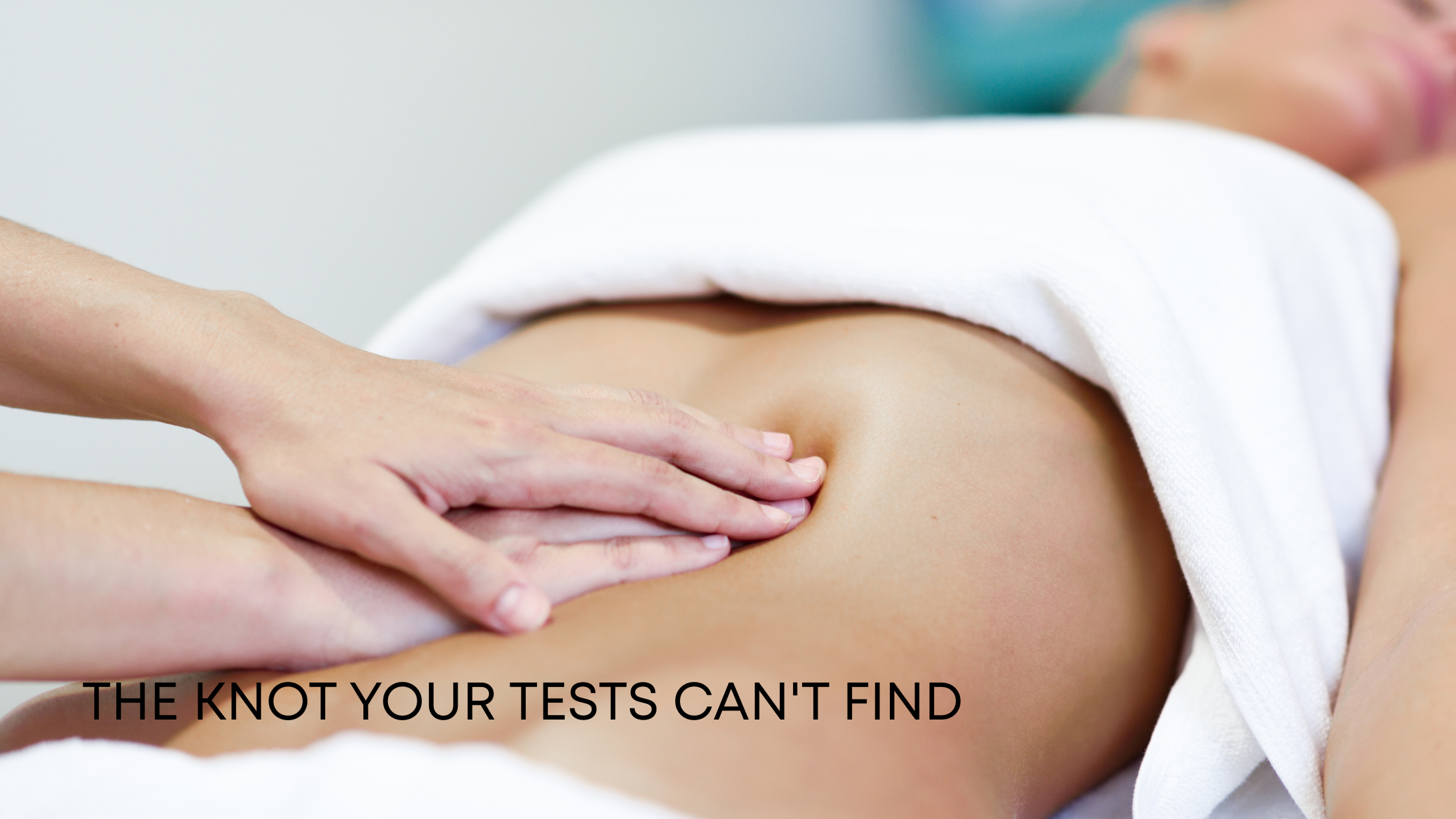
Then I press into the abdomen — and I find pretty clear patterns.
Right under your ribs, at the center point along the diaphragm, more than half of the women I work with scowl when I press in here and say it’s uncomfortable. Meanwhile, I feel the constriction in their belly that should be soft.
In Chinese medicine, when that center point is tight and reactive like this, it’s called a “pi” — sometimes translated as a glomus, a knot of stuck, congested energy that hasn’t been able to move.
Closer to 80% have tenderness somewhere across that whole epigastric area, showing that the diaphragm probably isn’t able to move as freely as it wants to because of stored tension.
This is evidenced by looking at their breath, too.
The second spot I pay attention to is just above the belly button. If there’s a strong, insistent pulse there, it tells me the body has been pushing too hard, for too long, without enough recovery.
Why are these tension patterns so widespread?
The diaphragm is where stress physically lives.
When your sympathetic nervous system fires — the “get ready” system — your diaphragm contracts. Your breath goes short and shallow. Blood shifts out of your organs and into your muscles, because your body is preparing to run, fight, or brace for whatever’s coming.
Energetically, we’d say the body locks down so energy pools instead of moving evenly through the whole system.
Under ideal circumstances, once the threat passes, the diaphragm relaxes again. That’s the design.
But after a single overwhelming event, or — far more commonly in this clinic — after a long stretch of stress with no real chance to recover, the diaphragm doesn’t get the memo. It stays contracted.
The stress gets patterned into the tissue itself.
I don’t think I’ve met a mother who doesn’t carry this.
It’s just as ubiquitous in ambitious women, women with high standards for themselves, women who are quietly running three lives at once.
This is why so many women live with a permanent knot in their stomach — even when every test comes back normal.
But this isn’t just a belly issue.
The consequences are widespread.
What a locked diaphragm can produce: heart palpitations, chest tightness, headaches, migraines, digestive trouble, insomnia, restlessness, exhaustion, muscle tension and pain, worse menstrual cramps, PMS, and other hormonal symptoms.
And because the body and mind are one interlocked system, it doesn’t stop there.
Your microbiome shifts in direct response to stress.
Neurologically, the signals traveling from a tense diaphragm back up to your brain send a clear message: it is not safe to relax.
Depending on how much energy your body has left to respond with, that message shows up as anxiety — or, when the tank is empty, as shutdown, apathy, or depression.
Part of what locks the diaphragm in place is that there was never any space to feel.
Back in grad school, I didn’t have the tools yet to know what to do with the stress I was feeling, so like most of us, I defaulted to what I’d been taught: power through.
Fix the problem instead of feeling what the problem stirred up.
It wasn’t until I learned to work differently — with my body, not against it — that the brick wall around my stomach actually started to soften and crumble.
This is the pattern I see in almost every woman who walks through our doors.
Not a lack of willpower. A lack of space — and permission — to feel.
The way out isn’t to override harder. It’s to feel in — to soften around the sensation instead of tightening against it, to let yourself actually feel what’s there instead of managing it from a distance.
When you allow the sensation instead of fighting it, it can start to unwind.
And eventually, it moves out. The nervous system repatterns itself, and so do your tissues and physiology as a whole.
How we work with it.
There’s no single fix for a pattern this layered, so we don’t use just one.
We use targeted acupuncture points shown to relieve diaphragmatic tension and dissolve a pi when it’s present.
We use craniosacral therapy, myofascial release, and visceral manipulation to work the surrounding tissue directly — because tension in the diaphragm is almost never isolated. It travels: into the ribcage, the shoulder blades, the sternum, the throat, the jaw, the occiput. The exact map is different in every body.
We also use medical qigong, guiding qi directly through the points of constriction to dissolve them from the inside and restore vitality rather than just release tension.
And in Applied Somatic Medicine™ sessions, we guide you through meditation — because your own felt awareness of what’s happening in your body is just as essential as anything we do from the outside.
When it’s useful, we layer in herbal medicine, nutrition, movement, and lifestyle support to reduce the ongoing stress load and build back your capacity.
This is what a tight diaphragm actually is: not a symptom to manage, but a body that has been asked to override its own signals for far too long.
Want to experience Applied Somatic Medicine™ for yourself?
We can’t wait to see where this takes you.