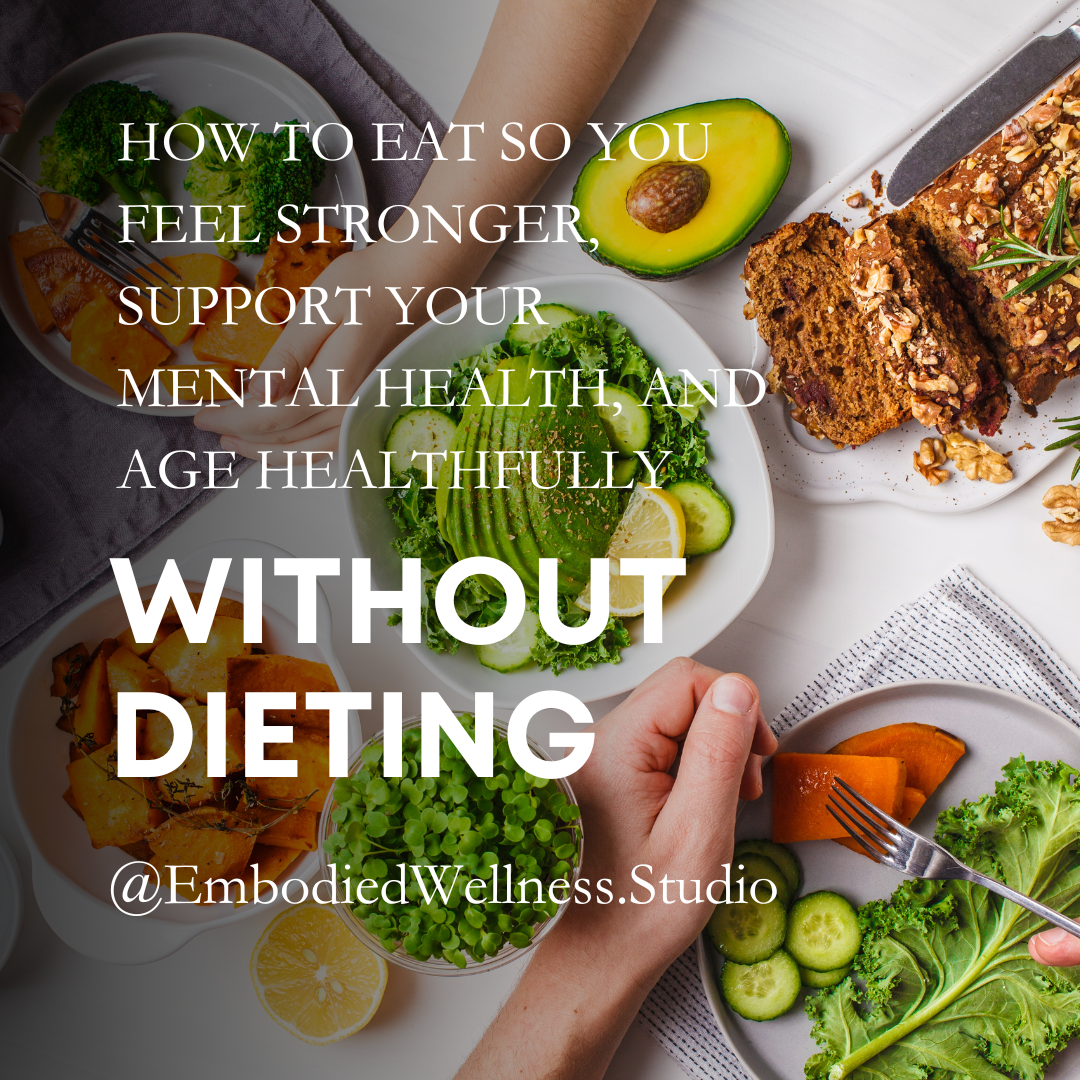
How to Eat Healthy Without Dieting
Tell me if this sounds familiar.
You’ve been battling against your body for as long as you can remember—at the very least since puberty. You can’t count how many diets you’ve been on, and “failed”. But a point came where, after years of self-torture, it just became too exhausting and you realized you had to find another way.
Now you’ve done enough inner work to *finally* feel ok around food. You’re not starving yourself anymore, and you no longer feel like a nervous bunny that’s under attack when someone invites you out to eat.
You might not be thrilled with the way your body looks all the time, but you’ve come to accept it enough to LOVE what it does for you.
It has taken you a loooooong time and a mountain of effort to get here, so when someone tells you that you that if you want to age with strength and vitality, you have to pay attention to your diet? You don’t want to hear it.
I get it. I’ve been there.
And that feeling of freedom you now have around food after years of restriction is not something I will ever tell you to give up.
But the inconvenient truth is that the food you eat (or don’t eat) does have an impact on how you feel, how your body functions, and how healthfully you’ll age.
So if this sounds like you, (and every woman I know is either in the throes of disordered eating or has a history of it,) here’s what I suggest:
Change your mindset from restriction to nourishment.
When you focus on nourishment, you’re not worrying about what that piece of cake will do to your thighs. Ok, you might still be worried about that, but you’re going to practice replacing those thoughts with new ones.
Now you’re going to start thinking about how the food you eat will help you *feel* more than how it will make you look.
The simple truth is that when you feed your body the nutrients it needs—when you pay attention to protein, fiber, and plant diversity—you’re going to feel better. You’re going to perform better. You’re going to have less cravings and more enjoyment in eating. And if vanity is still a factor for you (and let’s be honest, it is for all of us,) the good news is that a nourishment mindset will help you look better, too.
Here are some things to start paying attention to when you adopt a nourishment mindset:
• Try to get 20-40g of protein at every meal
Notice how you feel and what changes after 2 weeks of doing this (hint: I’ll bet you a buck that your sugar cravings and energy crashes will be a thing of the past).
Weighing and tracking food can be a great way to learn how much protein and fiber is in different ingredients, but if this is triggering for you, just try to eat a handful of protein-rich food at every meal.
Good options include tempeh, tofu, wild-caught fatty fish, quinoa, (sprouted) beans and rice, regeneratively-raised or wild meat products, eggs, and dairy.
• Aim for 25-30+g of fiber per day
A great way to hit this goal is to fill at least half your plate with vegetables.
Great fiber-rich options include brassicas (broccoli, cauliflower, Brussels sprouts, cabbage, etc.), whole grains, nuts, seeds, legumes, soaked/rinsed (and sprouted, if you can) cooked beans, raspberries, apples and other fruits.
• Count the number of plants you’re consuming, and try to eat at least 20-30+ different plants per week.
Fruits, vegetables, nuts, seeds, legumes, grains, spices, and herbs all count!
• Include probiotic foods in your weekly rotation.
Good options include fermented vegetables, sauerkraut, live-culture pickles, kefir, tempeh, low-sugar kombucha, etc.
The exact amount that works for you will depend on your constitution, but generally 3-7 servings per week is a good goal.
• Check in with yourself: How do you feel after eating pro-inflammatory foods?
These include white sugar, ultra-processed foods (almost everything in a package) with additives, gums, preservatives, and emulsifiers, cured and processed meats, fried foods, alcohol, rancid oils, and any foods you may be sensitive to (for some people: eggs, dairy, gluten, nuts, nightshades, citrus fruit, etc.)
Check in with yourself 20 minutes later, 3 hours later, the next morning and over the next couple days.
Symptoms to look out for include:
Insomnia
Gas, bloating, abdominal discomfort, acid reflux
Anxiety
Depression
Lethargy/exhaustion
Apathy
Mood-swings
Acne, eczema, skin redness
Muscles pain
Headaches, migraines
Menstrual cramps
PMS
General malaise
These are general recommendations that will help most women, but this is just the beginning.
Because the foods, lifestyle strategies, and treatments that will work for you are unique, and we all need personalized support to help us feel our best.
If you’re struggling with any of the above symptoms, just want to feel a little better, or already have more chronic, debilitating issues and are craving more support, click here to make an appointment at The Embodied Wellness Studio now.
We can’t wait to see where this takes you!