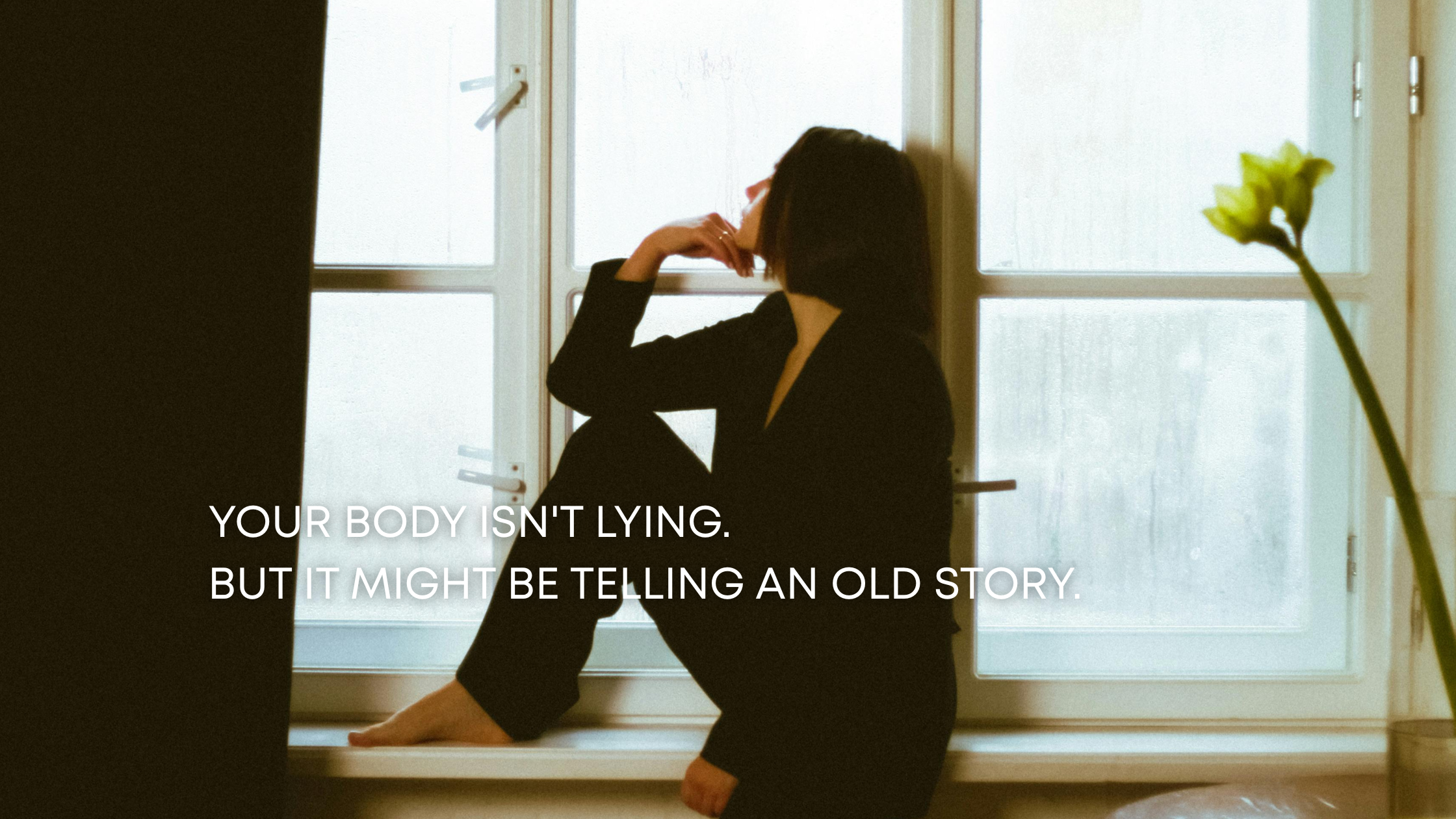
You Think That’s Your Intuition Talking. It Might Not Be.
On anxiety, intuition, and the thorn I couldn’t pull out myself.
Most women I know have been told to trust their gut.
And most of the women I know have, at some point, trusted the wrong thing — and called it intuition.
I was one of them.
What I almost walked away from because of it brings up something I have no words for — a grief for what I almost lost, but thankfully, didn’t.
When I think about it, I want to reach back and hold the younger version of me that was so scared. Reassure her that she was making good and wonderful choices, even when she couldn’t feel it.
By the time you finish reading this, you’ll understand the difference between anxiety and intuition — not as a concept, but as something you can actually feel in your body.
And you’ll understand why that difference changes everything.
When I met Adam, my now husband, something felt different.
He paid attention. He looked me in the eye and actually wanted to hear how my week was — not as a formality, not as a preamble to talking about himself, but because he genuinely wanted to know. Our values were aligned. We had fun together. It felt easy.
Too easy.
And the more real our relationship became, the tighter my stomach got.
My family started falling apart right around the time I was becoming aware of my environment. At seven, we hit a financial crisis and lost many of the physical comforts I’d grown up taking for granted. By nine, my parents had separated and I was living alone with my mother, who had become severely depressed — going through perimenopause, I now realize, with what I imagine was very little support.
I grew up craving the safety of a deep and loving relationship without trusting that I was capable of having one. Or that anyone else was capable of being in one with me.
I made excuses for men’s bad behavior. And as a result, I encountered a lot of it.
So when Adam entered the picture, my body went into high alert. And my mind did what minds do: it tried to solve the stress by explaining it, and by creating an exit plan.
The story that felt safest to my nervous system was that Adam wasn’t the one.
That I wasn’t attracted to him enough. That there had to be someone better out there for me.
And yet I stayed. Because he kept showing up.
No matter how much I tested him — and I tested him a lot — he held space for my chaos and brought me back to earth, over and over and over again.
I remember the moment I understood something was shifting in me.
We were walking in a field and I stepped on a thorn. My instinct was to dismiss it, keep walking, handle it later — or not at all.
That was my default. Don’t make a fuss. Don’t need things. Don’t slow anyone down.
This was the lie I had absorbed so completely I didn’t even know it was a lie.
That needing someone was weakness. That depending on another person was a risk no strong woman should take. That the safest version of love was the kind where you never truly let anyone in.
But Adam stopped. He gently picked up my foot and pulled the thorn out.
It was such a small thing. And it cracked something open in me.
I had been walking on thorns my whole life, calling it fine.
If I had listened to the advice floating around about intuition these days — trust your gut, if something feels off it probably is, your body never lies — I would have left.
We live in a culture that has made an art form of leaving.
Of cutting ties with anything that doesn’t feel good, doesn’t flow easily, doesn’t immediately serve you.
Disposal over repair. Comfort over depth.
And sometimes leaving is absolutely the right choice.
But sometimes — and this is what nobody warns you about — the discomfort you’re feeling isn’t a signal to go.
It’s a signal that something real is happening.
That you’re being asked to grow into more than your nervous system currently knows how to hold.
I almost left. And I would have lost the best relationship of my life.
Because the tightness in my stomach wasn’t intuition.
It was anxiety. And I didn’t know the difference.
The Body Tells the Truth. But It Doesn’t Always Mean What the Mind Thinks It Means.
The body doesn’t lie. But the meaning we assign to what the body is saying — that part goes through the mind. And the mind is not a neutral translator.
The mind is a pattern-recognition machine.
It is shaped by everything that has ever happened to you — your childhood home, your early relationships, the messages you absorbed about who you were and what you deserved and how safe the world was.
By the time you’re an adult, those patterns are deeply grooved.
They run automatically, below the level of conscious awareness.
So when your body sends a signal — tightness in the chest, a knot in the stomach, a sudden urge to flee — your mind reaches into its library of past experiences and finds the closest match. And then it tells you a story.
That story feels like truth. It feels like your gut speaking.
But what it often is, is the past speaking. Old conditioning, old fear, old protection — dressed up as present-moment wisdom.
This is not only about relationships.
It’s about every domain of your life where you’ve been shaped by experiences you didn’t choose — the job you stay in because ambition feels dangerous, the boundary you can’t set because need feels shameful, the rest you won’t take because stillness feels like failure.
The body responds to all of it. And the mind interprets all of it through the same worn grooves.
When you’ve spent years learning that the world isn’t safe, your nervous system will find evidence of that everywhere. Even in the places that are actually safe.
This is what nobody tells you about intuition: it requires a regulated nervous system to access it clearly. You cannot hear it when the alarm is going off.
Anxiety and Intuition Feel Different — Once You Know What to Look For
Anxiety is loud.
It is urgent. Consuming. It moves fast, talks fast, wants to act fast.
It is run by the part of your nervous system that responds to threat — heart rate elevated, breath shallow, muscles tense and contracted, mind churning through scenarios.
It pulls you toward the surface of things. It wants to solve, escape, control, explain.
Anxiety sounds like: Something is wrong. I need to figure this out. What does this mean? What should I do? What if I’m making a mistake?
Anxiety is the white water at the surface of a river — loud, churning, visible, consuming. All your attention goes there. It is hard to look away.
Intuition is something else entirely.
It is not loud. It does not demand immediate action.
It is steady and patient and does not explain itself, because it doesn’t need to. It lives beneath the urgency, beneath the noise, beneath the story your mind is spinning.
Intuition is not a feeling so much as a foundation.
It is the space within which the storm is held. The stillness underneath.
Subtle, expansive, present — but nearly impossible to access when the anxiety alarms are going off.
It is the deep, strong undercurrent running beneath the white water. Always moving. Always there. But invisible when the surface of the river is turbulent.
When anxiety churns, intuition disappears from view.
What Changes When the River Clears
I did not learn to hear my intuition through journaling, or affirmations, or thinking harder about what I really wanted.
I learned it on a treatment table.
It was in the somatic work — the acupuncture, the craniosacral therapy, the medical qigong, the herbal medicine — that I began to understand what my body had been holding…because it was finally able to release.
Not as a concept. As a physical reality.
When the body contracts around a perceived threat — real or remembered — something structural happens.
The fascia tightens. The breath shortens. The organs pull inward.
The nervous system narrows its focus to survival.
This is not metaphor. It is measurable, observable physiology.
And what I have found, both in my own life and in years of clinical practice, is that you cannot think your way out of a pattern that lives in the body. You have to unwind it at the level where it was stored.
As that unwinding happened — slowly, layer by layer — something else became possible.
Space.
Not forced calm. Not performed peace. Real space — the kind that arrives when the body is no longer contracting around old fear. When the tension softens. When the river, still moving, begins to run clear.
The women I work with describe the feeling after sessions as lighter.
That word comes up again and again. Lighter. More spacious. Free.
Not fixed, not finished — just carrying less. And in that lightness, something shifts.
They become less reactive and more responsive.
Less driven by the urgency of old protection, more connected to what they actually want and know.
They become braver — not in a way that feels like forcing themselves, but in a way that feels like returning to themselves.
Choices they couldn’t make before become available. Relationships that once would have sent them running become ones they can lean into. The body opens.
And the life opens with it.
Adam and I have been together for more than fifteen years now. We have two boys. We have a life I genuinely love.
And I almost left before it started because I didn’t know that the alarm going off inside me was grief, not guidance. A nervous system doing its best with what it had — not a truth about who he was, or what we could be.
Your body is not lying to you.
But if anxiety has been your baseline for a long time, you may not yet be able to hear what it’s actually saying.
The work — the real work — is not learning to trust your gut. It’s learning which gut you’re listening to.
The one contracting around the past.
Or the one, cleared and still, that knows.
If this resonated, start with the Somatic Override Quiz. Two minutes. It gives you a clear picture of where your nervous system is right now.
Now accepting new patients in the Portland Metro area and online. Book now.