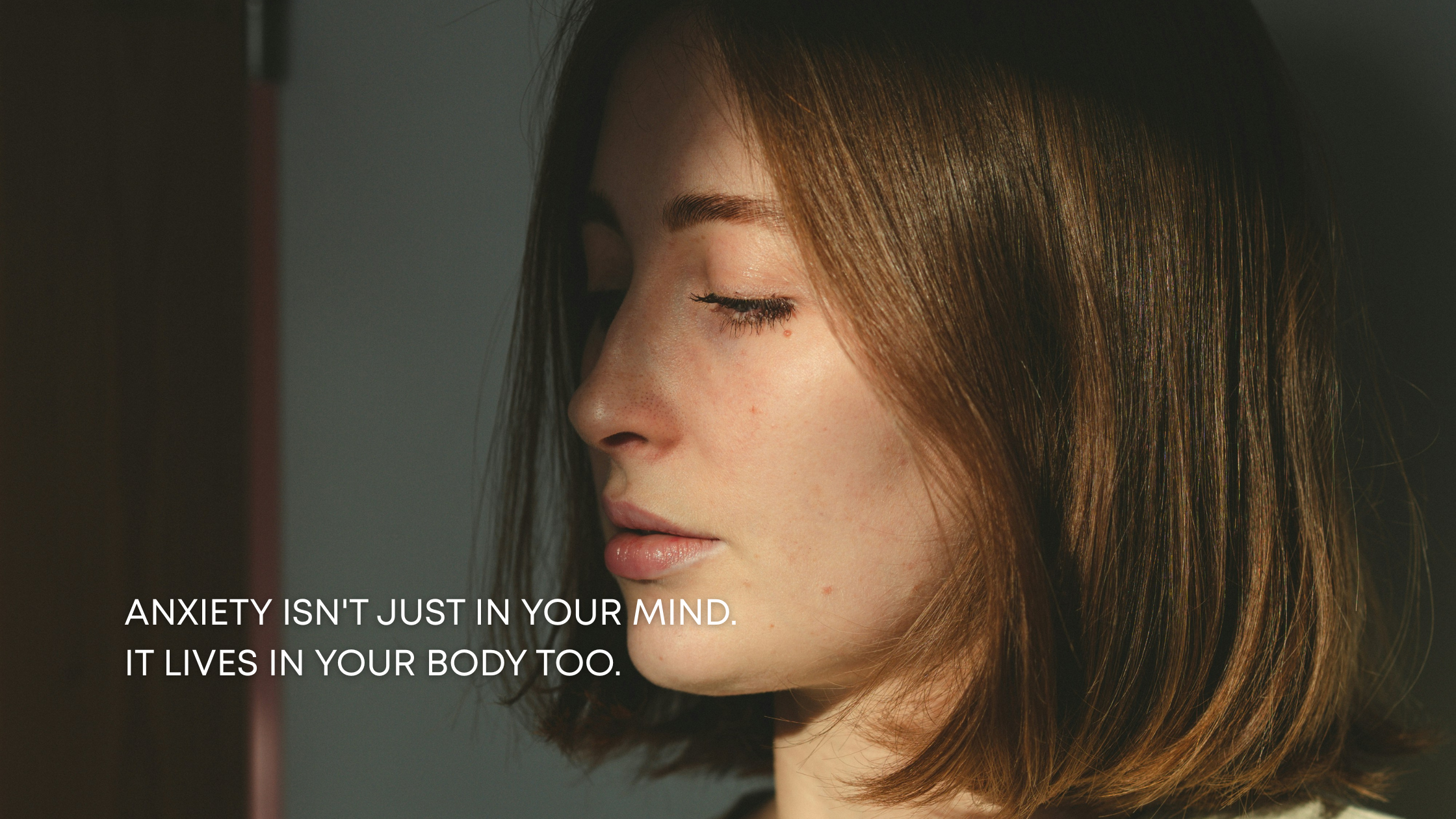
For years, I prided myself on not crying.
I thought it meant I was strong. Steady. That I had it together in a way that other, more emotional women didn’t.
Then I started getting a stomachache I couldn’t explain.
It felt like someone had built a brick wall around my midsection — solid, immovable, relentless.
It got so uncomfortable that I went to the doctor. She poked around, ran blood panels, prescribed licorice pills. I got an ultrasound. Everything came back clean. Nothing wrong. Nothing to find.
But it didn’t go away.
At least not until I let myself feel.
Until I let my body move the way it wanted to move.
Until I let myself sob — really sob — all the tears my body had been holding back for years, waiting for a moment safe enough to finally let them fall.
That was the beginning of understanding what anxiety actually is.
We Were Taught That Feelings Are the Problem
Here’s what most of us were shown, directly or indirectly, about emotions:
That they’re weakness. That they’re inconvenient. That they make you difficult, dramatic, too much.
Men are permitted anger — it reads as strength, authority, passion.
But women are only permitted cheerful compliance, and not much beyond that.
Stray outside it and you already know the words. You’ve heard them. You’ve probably said them to yourself.
Too sensitive. Too emotional. Too much.
So we learned to hold it together. We turned the volume down on what we felt, got very good at pushing through, and wore our steadiness like armor.
What none of us were told is how that suppression impacts not just your emotions, not just how you feel, but literally the physiology of the body.
In Chinese Medicine, Emotions Are Energy
This isn’t a metaphor. You can see it in the chemistry of the hormones that are released when you feel a certain way.
And in Chinese medicine, emotions are understood as forms of energy — qi — that are meant to move through the body the way wind moves through grass. They arise, they flow, they complete, they pass.
Every emotion has a direction. Grief descends. Anger rises. Fear contracts. Joy expands.
When emotions flow freely, the body stays in balance.
But when we judge an emotion as unwanted — when we decide that what’s arising is too much, too inconvenient, unwanted, uncomfortable, too threatening to let ourselves feel — we do something specific with it.
We contract around it.
We tighten. We hold. We build a wall.
And here is the thing that changes everything once you understand it:
The emotion itself isn’t what causes suffering. The contraction we impose around it is.
The grief, the anger, the fear — those are energy that wants to move. They’re not dangerous. They’re not permanent. They don’t mean something is wrong with you.
But the effort required to hold them back — to maintain that wall — is enormous.
It requires the full force of your stress response. Your tissues contract around what wants to flow. Your muscles hold the shape of everything you didn’t let yourself feel. Your body becomes a storage unit for unexpressed life.
And then your mind, sensing all that stored tension, does exactly what it’s designed to do.
It tries to fix it.
The Loop Nobody Talks About
The nervous system doesn’t separate brain from body.
It is one continuous system — a constant, bidirectional conversation between what’s happening in your tissues and what’s happening in your thoughts.
This is why gut health affects mood. Why exercise changes cognition. Why what we think shapes how we feel in our bodies, and why how we feel in our bodies shapes what we think.
When tension is stored in the body — when you’re chronically tightening around emotions you’re not allowing to move — the nervous system reads that as a threat. Not because something is actually wrong. But because held tension registers the same way physical danger does.
So the mind responds the way it always does to perceived danger.
It sends anxious thoughts.
What if something goes wrong? What if I can’t handle it? What if it’s already too late?
Those thoughts create more tension. That tension signals more threat. More anxious thoughts arrive to address it.
And around it goes — not because you’re broken, not because your mind is lying to you, but because the body is speaking a language the mind hasn’t been taught to understand.
Mary Oliver wrote: “You do not have to be good. You do not have to walk on your knees for a hundred miles through the desert, repenting. You only have to let the soft animal of your body love what it loves” — to feel what it feels, move as it wants to move, and rest as it craves to rest.
That is not indulgence. That is medicine.
Anxiety Lives in the Mind. But It Moves Through the Body.
Most anxiety treatment starts — and ends — in the mind.
Reframe the thought. Challenge the cognitive distortion. Journal it out. Understand where it comes from. Think your way to a different conclusion.
And the mind is part of this. It’s important too.
Thoughts shape how we feel in our bodies. Beliefs create tension. The stories we tell ourselves about what’s happening matter.
But we have made the mind the only tool. And it was never designed to do this alone.
We are a culture that lives above the neck.
We are rewarded for analysis, for problem-solving, for being articulate about our inner lives.
We can name our patterns, trace them back to childhood, explain exactly why we are the way we are — and still feel just as anxious, just as tight, just as unreachable to ourselves.
Because the mind can describe an emotion. It cannot complete one.
Emotions don’t live in the prefrontal cortex. They live in the body — in the chest and the gut and the throat and the hips.
They move through tissue.
They complete through sensation, through breath, through tears, through the trembling your body does when it finally feels safe enough to shake loose what it’s been holding.
You cannot think your way through a feeling that lives in your fascia.
The body is not a footnote to the mind. It is the place where emotions are actually felt, actually processed, actually released. And most of us — high-functioning, intellectually capable, deeply self-aware women — have been so focused on solving our anxiety that we forgot to feel it.
That doesn’t mean there’s something wrong with you. It’s what we were trained to do.
But it is why the anxiety doesn’t go away.
This Is Also a Bigger Problem Than We Admit
We talk a lot about the impossible load women are carrying — and it’s real. We’re doing the work of what used to require an entire village, without a village to lean on. That is a structural crisis, and it belongs on the table.
But there’s another layer.
We are also creating additional stress by refusing ourselves what the body actually needs.
We don’t give ourselves real recovery because we call it a luxury, as if it were a bonus or reward, rather than the essential foundation on which our lives are literally built— sleep that isn’t negotiated away, nourishment that isn’t rushed, movement that isn’t punished, connection that isn’t scheduled around everyone else’s needs.
And underneath all of that: the permission to feel what we actually feel.
Because those feelings are not the enemy. They’re information. They’re the body’s attempt to communicate something true.
If they feel overwhelming or volatile — if they seem like too much to let in — that’s usually because they’ve been waiting a long time. And the message they’re carrying isn’t usually what the mind says it is.
It’s rarely this situation is going to destroy you. It’s almost always something simpler: this needs to be acknowledged. I need to be felt. I need to be allowed to move.
Anxiety is, more often than not, the mind’s attempt to manage a future that hasn’t arrived yet.
It’s trying to solve, prevent, control an outcome that isn’t here. And it cannot be fixed from that time and place, because the problem isn’t in the future.
It’s in the body. Right now. Asking to be met.
Yes — if you are in danger, leave.
If action can be taken to improve something real, take it.
But if what’s present is a low hum of dread about something that isn’t here, an exhaustion that sleep doesn’t touch, a stomach that hurts for no reason the doctors can find —
The most radical thing you can do is stop trying to think your way out of it.
And let your body feel its way through.
What This Actually Looks Like
You don’t have to go looking for big emotions. You don’t have to manufacture a breakthrough.
You start by creating conditions the body can trust:
Sleep that is protected, not negotiated.
Food that is real and eaten slowly enough to taste.
Movement that comes from pleasure, not punishment.
People who are safe to be imperfect around.
Beauty. Laughter. Moments of genuine, unproductive rest.
And when something arises — tightness in the chest, a sudden sting behind the eyes, a flicker of something you can’t name — instead of immediately suppressing it, you pause. You breathe. You let the body do what it’s asking to do.
You let the soft animal feel what it feels.
Over time, the wall begins to dissolve. Not all at once. Not without discomfort. But the body, given enough safety, enough permission, the right kind of support, knows exactly how to release what it’s been holding.
That’s not weakness.
That’s the most intelligent thing a nervous system can do.
If you recognize yourself in any of this — if your anxiety has a physical address in your body, if your symptoms have no explanation, if you’re exhausted from holding everything together — the Somatic Override Quiz was designed for exactly this. It takes two minutes and tells you what your nervous system is actually asking for.