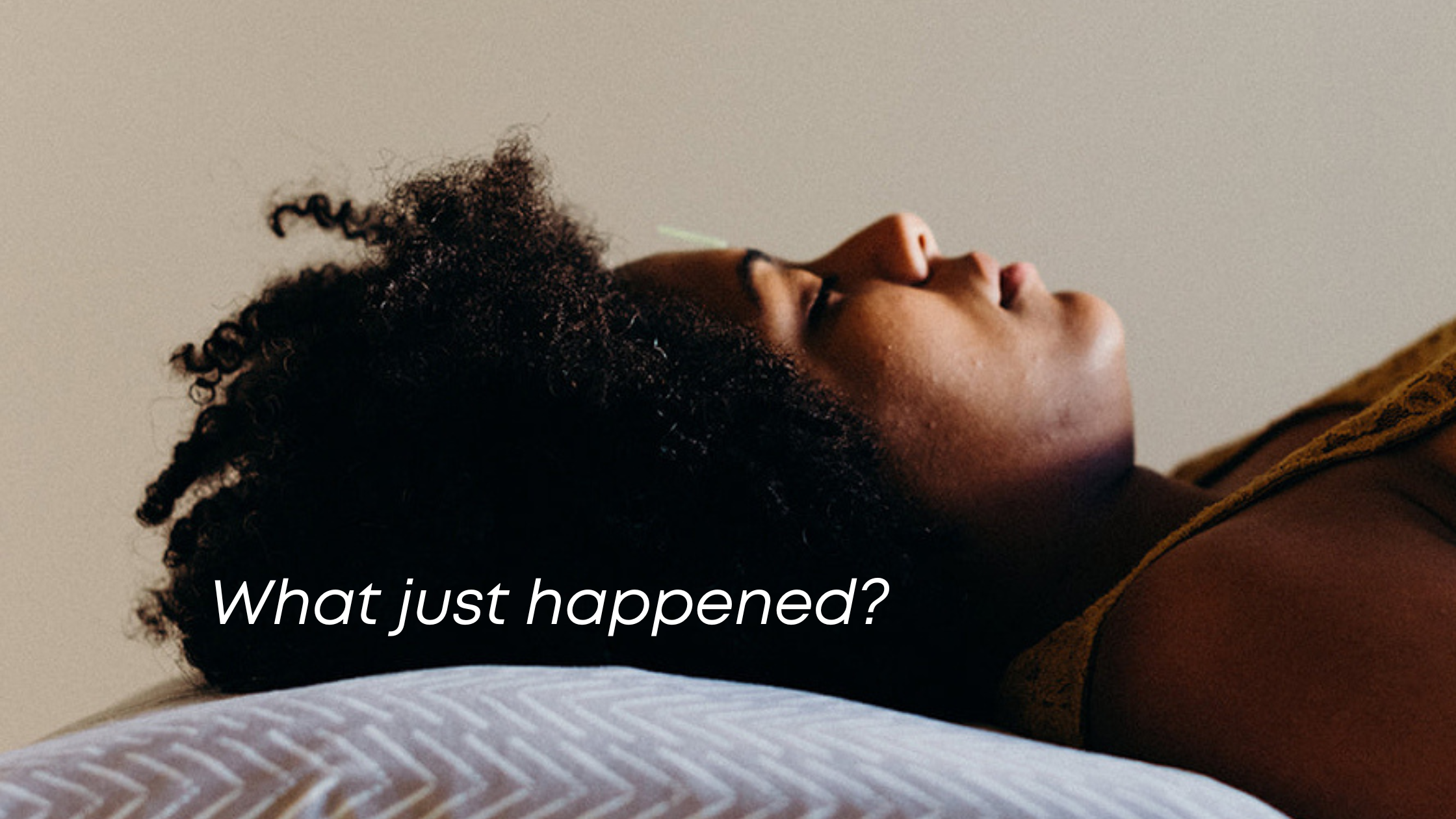
She sits up slowly.
Her hair is a little disheveled.
There might be mascara tracking down one cheek.
And her face holds two things at once that I’ve come to recognize as a very good sign: a kind of glow, and a kind of bafflement.
What just happened? she’ll ask. What was that?
I’ve been asked this question more times than I can count.
And for a long time, I didn’t have a clean answer.
I had pieces — things I’d learned from Chinese medicine, from qigong, from craniosacral work, from years of sitting with women in the particular way that this work requires.
But the why — the real architecture of why somatic medicine can feel, to the uninitiated, like something slightly miraculous — that took longer to understand.
I’m still putting it together. But I’ve gotten closer.
The Year Everything Changed
At the beginning of 2025, I had just taken the leap to open my own practice.
For the first time, I had the freedom to experiment — to layer techniques in the way that felt true to how I understood healing, without fitting them into someone else’s framework.
My patients felt better with treatment. They came back.
Some had significant shifts — a headache pattern that finally broke, sleep that returned after years of absence, a jaw that unclenched for the first time in memory.
But something was missing.
Or rather — something hadn’t been added yet.
I had already been layering techniques for years: acupuncture as the foundation, then the subtle deep-reaching bodywork I’d trained in — craniosacral therapy, myofascial release, visceral manipulation — each one adding a different quality of access to the tissue.
Hands learning a different language with each modality.
Then medical qigong, which brought something different again — not a different technique exactly, but a different quality of attention.
In my practice, qigong is hands-on work, hands functioning the way needles do but with a softer, more listening quality. Less insertion, more resonance.
Patients could feel the difference even when they couldn’t name it.
But the most significant shift came when I added something deceptively simple: a guided meditation at the start of treatment.
Not a relaxation script. Not ambient music with breathing cues.
Something more specific — an embodied meditation I built from two different practices I’d learned over the years and combined into something I hadn’t seen elsewhere.
Building the Meditation
The first influence came from a qigong shaking practice I learned in graduate school.
In that practice, you shake — deliberately, attentively — into each part of the body, one at a time.
Your head. Each vertebra. Each limb. Each organ.
The goal isn’t relaxation; it’s contact.
With enough repetition, you begin to feel the interior of your own body in a way most of us never have. You stop being a head carrying around a body and start being an entire, inhabited self.
The second piece came from a meditation I encountered somewhere along the way — a practice designed to help release the tension that builds from resistance and stuck emotion.
The original imagery was steam escaping through a window. Clean and effective.
But in my clinic, I began using something different: a river of light moving through the body. Not around it. Through it.
Here is where we borrow from physics.
I guide patients to zoom in — first to the level of the cell, then to the molecules inside the cell, then to the atoms inside the molecules.
And at the level of the atom, something remarkable becomes visible: what appeared solid is almost entirely empty space.
The nucleus, which seems like the solid center, is itself made up of energetic particles that pop in and out of existence.
What we experience as dense, tight, and immovable is, at its most fundamental level, mostly nothing at all.
So the river of light doesn’t just flow around the physical structures of the body.
It flows through all the empty spaces within which what appears physical arises.
Softening. Soothing. Not forcing anything — because forcing is exactly what we’re learning to stop doing.
Instead, inviting. Inviting everything that wants to stay tight, dark, or agitated to soften and release, when it’s ready. Without judgment. Without agenda.
And then, again and again: What do you feel in your body right now? Not what do you think — what do you feel? And now? And now?
Returning the patient, over and over, to the present moment of their own interior experience rather than the story their mind wants to tell about it.
Something else happens on the table too, something I’ve come to watch for and protect: spontaneous movement.
Shaking. Swaying. A limb that wants to stretch. Muscles that tighten before they let go.
The body, given permission, begins to move itself.
Part of my job is helping patients learn to feel the difference between movement they’re initiating — an attempt to fix or manage a sensation — and movement the body is generating on its own.
One is the Override. The other is release.
They feel different, once you know what to look for.
On the treatment table, with my hands also present in the body, what starts to happen is something I can only describe as coherence.
The patient’s inner attention and my outer attention meeting somewhere in the tissue.
And that meeting point is, I believe, where the magic lives.
Here’s where it gets interesting.
In quantum physics, there’s a well-documented phenomenon: the act of observing a particle changes its behavior.
This isn’t metaphor. It’s measurable.
The observer is not separate from what is being observed.
I am not a physicist. I can’t prove the body responds to conscious attention at a quantum level. But I’ve seen enough in clinic — and felt enough in my own body — to hold it as a working theory I’m not willing to dismiss just yet.
What I do believe: conscious attention is not passive.
It is an ingredient. It does something.
The three most profound herbal medicine experiences I’ve ever had all happened when I meditated immediately after taking the herb.
The first was Devil’s Club — a powerful Pacific Northwest plant with deep roots in Indigenous medicine.
Just two drops on my tongue, a meditation, and I found myself sobbing for about an hour. Not in grief, exactly — more like a pressure valve finally opening.
And afterward, the quality of my body felt different. Cleaner. The way the air feels after a storm has moved through.
The second, as many reading this might suspect, was cannabis — which I approached that day with deliberate somatic attention.
My body felt more free to move and flow than it ever had.
Something in my hips began to release in a way I can only describe as pushing out experiences that had been stored there, lodged in tissue, waiting.
It was not comfortable. It was profound.
I want to be clear: this is not an endorsement of cannabis as most people use it.
It is a stronger medicine than our culture currently credits it for — and dosage, intention, and frequency matter enormously.
Used casually or chronically, the effects are not always what advocates suggest. I approached it that day as medicine, with deliberate attention and clear intention. That distinction matters.
The third was a classical Chinese formula: Xiao Chai Hu Tang — a formula known for moving stuck qi in the middle of the body, in the liver and gallbladder, in the diaphragm.
With my attention turned inward, I felt tension I had been carrying in my diaphragm for decades — a holding I hadn’t even fully registered as holding — finally let go.
Each time: the herb alone hadn’t done that before. The meditation alone hadn’t done that before.
But with my attention directed inward at the moment the medicine was moving through me, something unlocked.
Physiologically, we can point toward what may be happening.
When attention is directed internally — when interoceptive awareness activates — the nervous system receives a signal that it is safe to downregulate.
And when that signal becomes consistent over time, the effects reach further than we once thought.
Research on the gut-brain axis tells us that the microbiome — the community of organisms living in the gut that profoundly affects mood, immunity, and resilience — is sensitive to chronic stress load.
When the body is able to move out of constant activation and reestablish a natural rhythm of tension and release, the gut environment changes too.
The microbiome literally becomes stronger.
The body, allowed to rest in a new way, reorganizes toward health at a level we can now measure.
Being witnessed, even by your own attention, changes what the body is able to do.
Why You Can’t Quite Replicate It Alone
I’ve noticed this in my own personal practice too.
When I do qigong or somatic work at home, by myself, the results are real — but they’re quieter. More maintenance than transformation.
The deepest shifts I’ve experienced have happened in two conditions: when I practice with others, in a shared field of intention, or when I’m working with an herb or plant medicine that brings its own quality of presence into the process.
Something about the addition of another awareness — whether human or botanical — seems to amplify what’s possible.
This matters especially now.
We live in a culture that has sold us a very compelling story about the virtues of self-sufficiency.
Handle it yourself. Figure it out alone. Need no one.
The myth of hyperindividualism runs so deep that most of us don’t even recognize it as a myth — we experience it as aspiration.
I should be able to do this on my own.
But we were not built for that. We were built for exactly the opposite.
Every healing tradition in human history has been communal.
The medicine circle, the ceremony, the ritual, the laying on of hands in community — not because ancient people didn’t know better, but because they understood something we have systematically unlearned:
Our actual strength comes from leaning on each other.
That is not weakness. That is biology.
And so when a woman lies on my table and finally allows herself to be held — even briefly, even by one other person — something in her nervous system responds to something ancient.
This is what I was made for.
Not the managing and the efforting and the going it alone. This.
The Hidden Obstacle: The Fear Beneath the Surface
There’s one more piece to this — the one I think matters most, and the one that’s hardest to talk about.
We work very hard, on a level far below our conscious awareness, to keep it all together.
The woman who comes into my clinic has usually been managing — heroically, relentlessly — for years.
Her nervous system has organized itself around the effort of not falling apart.
And somewhere in the deep, wordless architecture of her body, letting go feels dangerous.
Not because she’s broken. Because she’s human.
At the most primal level, the fear is something like: if I release what I’ve been holding, I won’t know who I am. I might lose control. I might fall apart completely. I might not come back.
There is often a second fear layered beneath that one, quieter and harder to name:
If I stop holding everything together, the people who depend on me will have no one.
This is the hyperindividualism myth at its most insidious — the belief that we are the only load-bearing wall in our own lives, and in the lives of everyone around us.
That our value is our function. That to rest is to abandon.
Neither fear usually lives in conscious thought. Both live in the tissue.
In the bracing of the jaw, the chronic holding of the diaphragm, the shoulders that curve forward, protecting the heart.
The body has learned to guard what it doesn’t yet trust is safe to release.
This is why having a skilled, trusted guide is not a luxury in this work — it is a clinical necessity.
The practitioner’s job is not just technical. It is relational.
It is about creating a container of safety sufficient for the nervous system to take the risk of letting go.
To trust, even briefly, that the other side of release is not oblivion — but rest. Space. The self, still intact, and finally able to breathe.
What Is Actually Happening in That Room
So when I try to answer the question — what just happened? — here is what I say:
Your body was given conscious attention. Your own, and mine.
And in that attention, in that witnessed space, it finally felt safe enough to release something it has been holding — maybe for years. Maybe longer.
The needles helped. The bodywork helped. The qigong helped. The herbs help. The lifestyle shifts help.
But what makes this feel like magic is the moment your body’s interior landscape becomes the object of attentive care, not management.
That is not magic. That is medicine.
It just hasn’t been practiced this way in a long time.

Katerina Baratta, MS, LAc
Founder of The Embodied Wellness Studio
Katerina Baratta, MS, LAc, is the founder of The Embodied Wellness Studio in Tigard, Oregon, where she practices Applied Somatic Medicine — a synthesis of acupuncture, somatic bodywork, medical qigong, craniosacral therapy, guided embodied meditation, and holistic nutrition and herbal medicine.
Her approach is both on and off the treatment table: treatment sessions work directly with the nervous system and tissues, while dietary, lifestyle, and herbal guidance support the whole person between visits.
She works primarily with high-functioning women navigating stress, burnout, and the physical symptoms that accumulate when the body has been running on override for too long — anxiety, chronic tension, insomnia, digestive issues, hormonal disruption, and the slow unraveling that comes from holding it all together.
→ Take the 2-Minute Chronic Somatic Override Quiz to identify your override pattern and understand what’s been driving your symptoms.